

Why DeepSeek V4.1 Flash Is Actually Good for SSDs
DeepSeek just released V4.1 Flash and one number is going to cause a lot of confusion.
The model only needs one eighth the persistent SSD storage for its KV cache compared to V4 Flash. The easy conclusion is that this is bad for SSD demand, but I think that completely misses what DeepSeek is showing us.
DeepSeek has now designed an advanced AI model around storing reusable inference data on SSDs. That is the real development here.
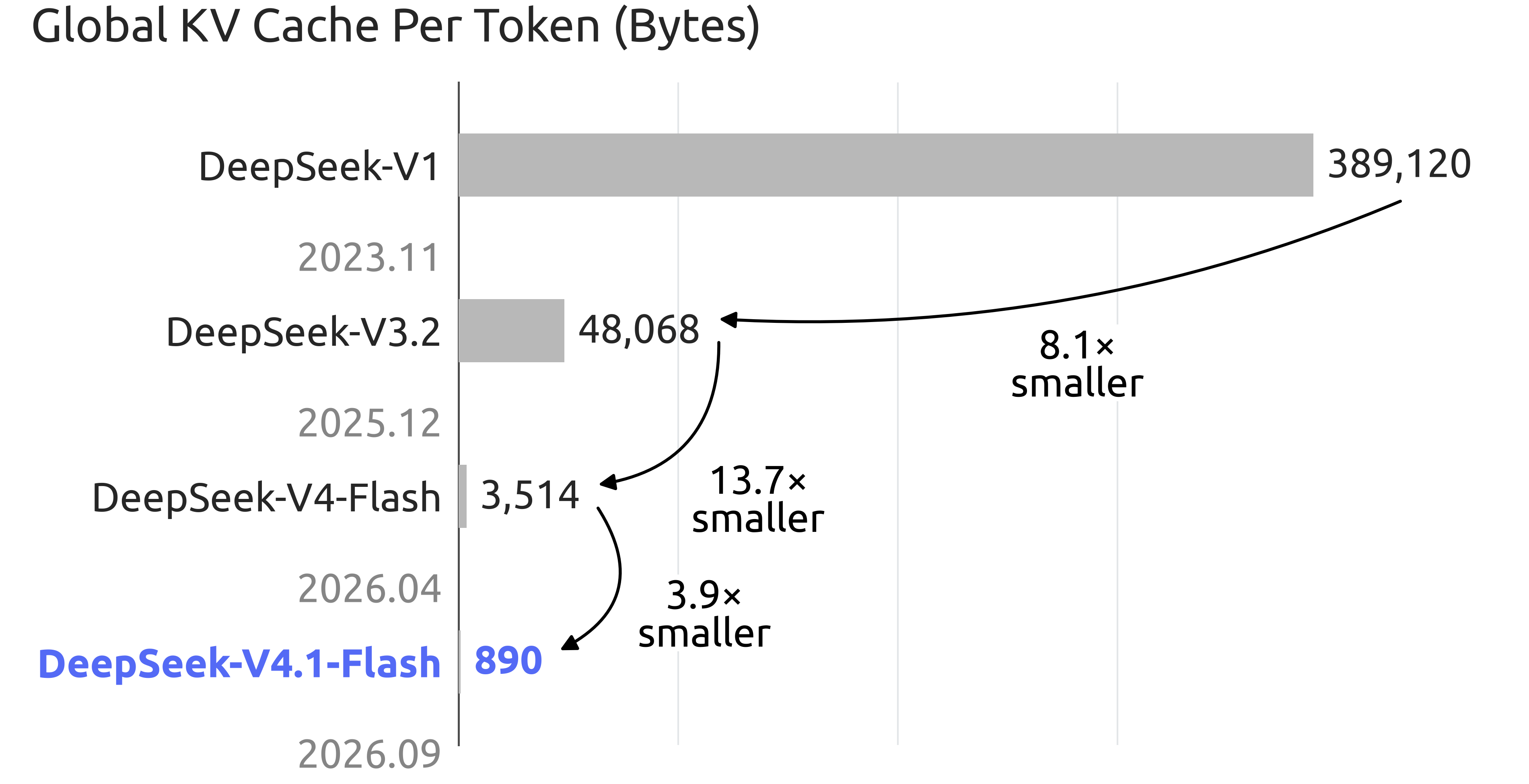
DeepSeek V4.1 Flash dramatically reduces both active HBM requirements and persistent SSD cache requirements. The important part is that SSD storage remains built into the inference architecture.
What DeepSeek Is Doing
When an AI model processes a prompt, document, codebase or conversation, it creates a KV cache. That cache holds work the model has already completed. If another request uses the same information, the model can retrieve the cache instead of making the GPUs process everything again.
This matters when thousands of users or agents are working from the same company database, codebase or large document. Reprocessing the same input over and over wastes expensive GPU compute. Saving that work and reusing it makes inference cheaper and faster.
HBM is the best place for data that the GPU needs immediately, but it is expensive and limited.
SSDs offer far more capacity at a much lower cost. DeepSeek’s architecture allows reusable KV cache to be stored on disk and loaded again when needed.
In simple terms, the SSD is storing AI work that has already been done.
Why Using Less Storage Can Still Be Bullish
DeepSeek reduced the persistent SSD footprint by roughly eight times. If the amount of AI usage stayed the same, that would obviously mean less storage demand. I do not expect usage to stay the same.
Lower inference costs allow companies to serve more users, run more agents, support longer contexts and retain more reusable data. DeepSeek V4.1 Flash supports up to one million tokens of context and is specifically designed for agent workloads. Making those workloads cheaper should expand how often they are used.
The calculation is not just how much storage one request needs. It is storage per request multiplied by the total number of requests and how long the data remains useful.
If storage per request falls eight times while agent activity grows twenty times, total demand still rises. That is essentially the same efficiency argument we have already seen across the rest of AI infrastructure.
Making AI cheaper does not necessarily shrink the market. It can expand the market much faster.
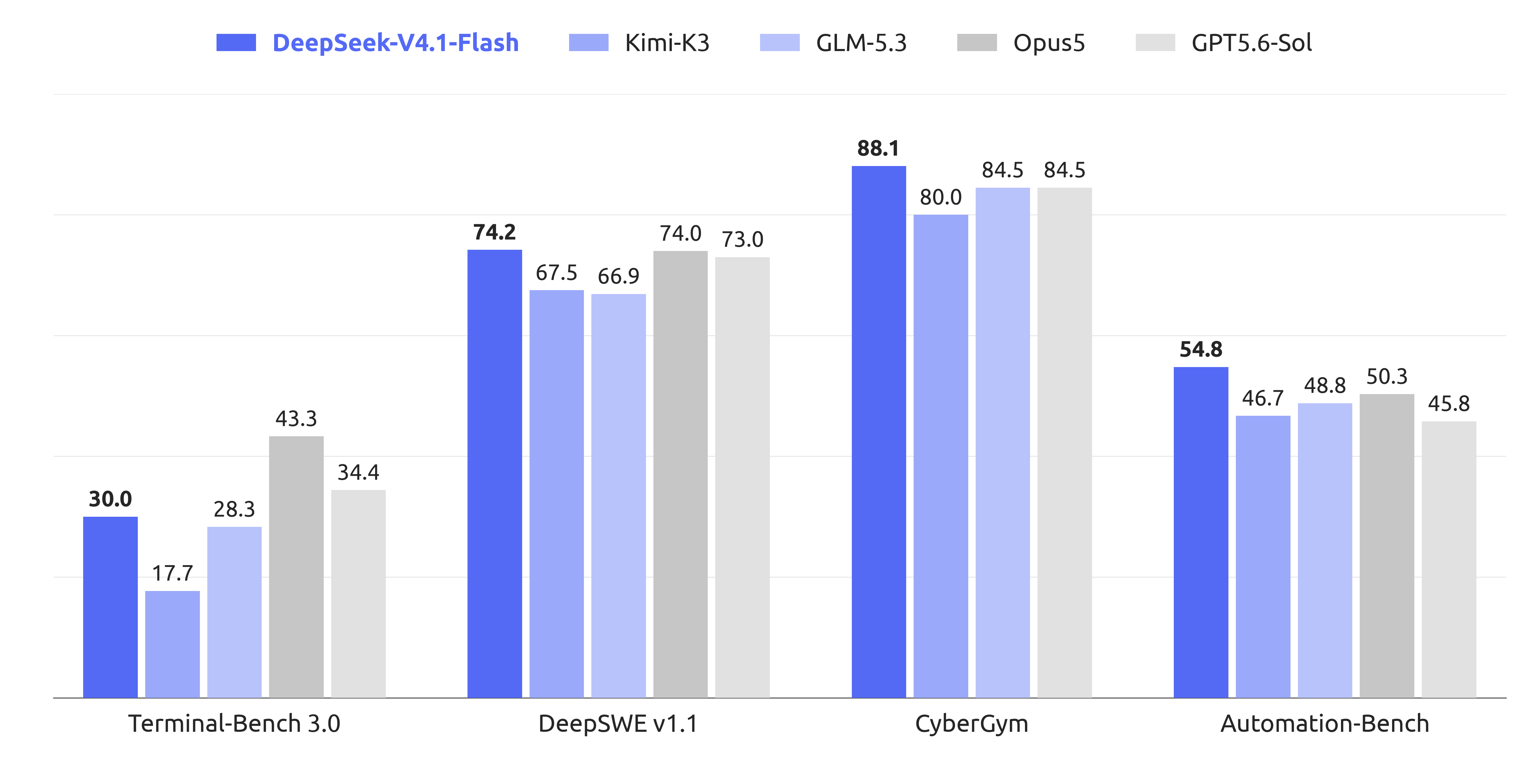
The storage reductions are not coming at the expense of agent performance. DeepSeek reports V4.1 Flash outperforming its previous Flash and Pro models across several agent benchmarks.
SSDs Are Moving Closer to Inference
This is more important than simply storing model files or training data. DeepSeek is using SSDs during the actual inference process.
Its original V4 architecture stored compressed KV cache on disk so shared prompts could be reused without another full prefill. V4.1 improves that system by cutting the global KV cache to 890 bytes per token and avoiding unnecessary writes of the much larger sliding window cache. It reconstructs that recent portion when needed instead of saving all of it.
That is how DeepSeek gets the persistent SSD footprint down to one eighth of V4 Flash. It is not removing SSDs from the system. It is making SSD backed caching efficient enough to use at a much larger scale.
DeepSeek even tells customers planning deployments with more than 2,000 GPUs and a storage cluster to contact the company. Putting the storage cluster next to the GPU count tells us how closely the two are becoming connected.
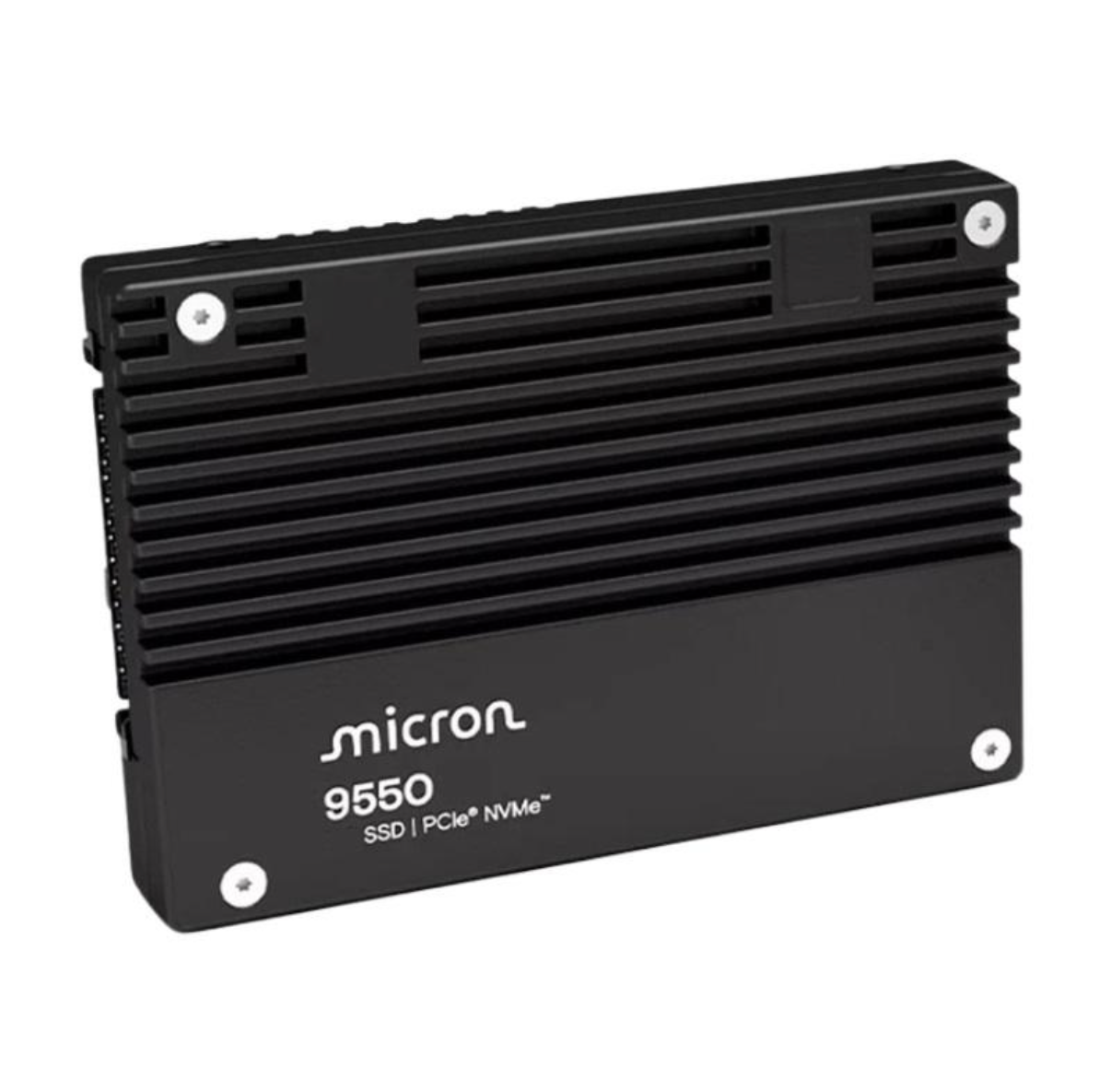
AI inference favors enterprise SSDs built for high throughput, consistent latency, endurance and large scale data center deployments.
A New Part of the Memory Hierarchy
HBM will continue handling the data closest to active GPU compute. DRAM will continue providing system memory. Enterprise SSDs can hold reusable KV cache, agent state, checkpoints, model data and frequently accessed datasets. Hard drives remain useful for colder data and archives.
That places SSDs between active memory and traditional storage. They are becoming a working part of the inference system instead of sitting in the background waiting for a model or dataset to load.
This should favor enterprise SSDs more than ordinary consumer drives. These workloads need capacity, endurance, consistent latency, fast random reads and controllers that can handle demanding access patterns.
The NAND manufacturers with strong enterprise products should have the most exposure, including $SNDK, $MU, Samsung, Kioxia and SK hynix through Solidigm.
It does not mean they all benefit equally or that this release creates an immediate spike in NAND demand. Product mix, customer qualification, controllers and endurance will matter.
The Bigger Picture
V4.1 Flash also includes 196 billion parameters of Engram conditional memory.
Engram uses sparse lookups to retrieve information instead of forcing the main neural network to repeatedly calculate everything it knows.
This points toward a wider change in AI architecture. Some repeated computation is being replaced with stored information that can be quickly indexed and retrieved. Compute demand can continue growing while memory and storage take on a larger role at the same time.
The surface level takeaway from DeepSeek is that SSD usage per cache fell eight times. My takeaway is that DeepSeek just validated persistent SSD caching as part of a large scale AI inference architecture.
The model uses less storage for each request, but that efficiency makes longer contexts, persistent agents and higher inference volumes much more practical.
SSDs are no longer only storing the data used to train AI. They are starting to store the context and completed work that AI needs to keep operating.
That is why I believe this release is structurally bullish for enterprise SSDs, even though the number everyone will focus on initially appears bearish.