

AI demand is still strong. The rates backdrop is the problem.
The AI trade does not suddenly have a demand problem. It has a rates problem, and the war with Iran has made an already difficult backdrop substantially worse.
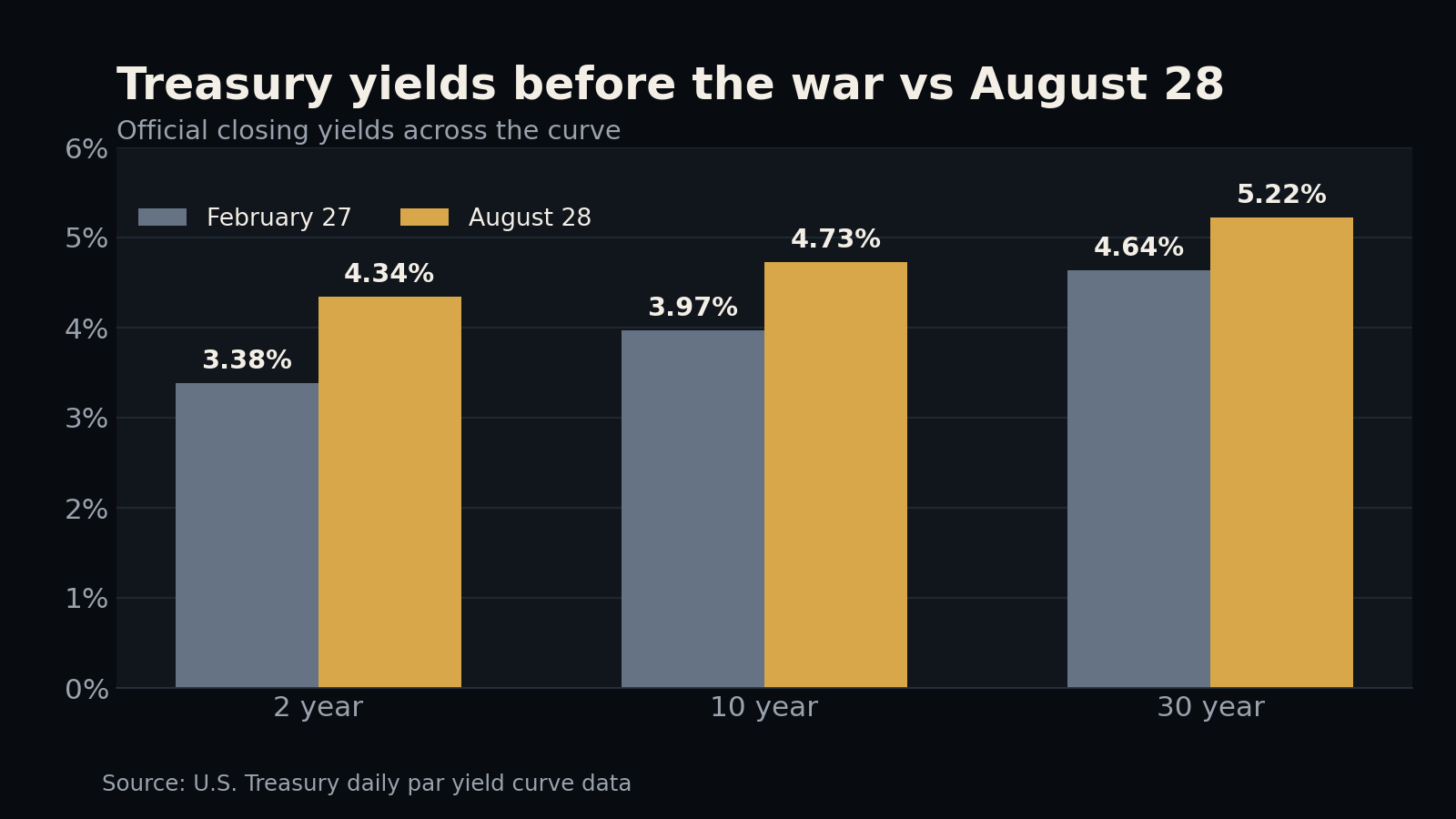
Before the war began on February 28, the 2 year Treasury yielded 3.38%, the 10 year 3.97%, and the 30 year 4.64%. As of the August 28 close, those yields had climbed to 4.34%, 4.73%, and 5.22%.
That is a 96 basis point move in the 2 year, 76 basis points in the 10 year, and 58 basis points in the 30 year without the Federal Reserve raising its policy rate once. These are nominal yields, but real yields have also moved aggressively higher. The 30 year real yield recently approached 3%, near its highest level in roughly 18 years.
This is the backdrop high beta AI has been trading against.
How Iran Reached the Bond Market
The war severely constrained shipping through the Strait of Hormuz and damaged regional energy infrastructure.
Oil surged, gasoline followed, and by May PCE energy prices were up 24% year over year. The Federal Reserve directly attributed much of that increase to the conflict and the disruption in oil markets. Total PCE inflation reached 4.1%, while core PCE remained elevated at 3.4%. Oil is not just another commodity in the inflation basket. It moves through transportation, manufacturing, agriculture, electricity, logistics, and eventually the prices consumers pay.
This is why the 2 year yield has risen so aggressively without an actual Fed hike. The bond market moved first and began pricing a higher probability that rates stay elevated or the Fed eventually has to hike again.
We saw that repricing accelerate at Jackson Hole. After Chair Kevin Warsh stressed that inflation remained above target and the Fed still had work to do, the market implied probability of a September hike moved from roughly 35% to 56%.
The Fed has not hiked, but the market has already tightened financial conditions for it.
Why High Beta AI Is Especially Exposed
Higher yields do not mean AI demand disappeared. They change what investors are willing to pay for that demand.
A large part of the high beta AI infrastructure trade is priced around earnings expected several years from now. When the discount rate rises, those future dollars become worth less today. The further out the payoff, the greater the valuation pressure.
This is why a company can report strong demand, raise guidance, and still sell off. The market is no longer asking only whether revenue will grow. It is asking how quickly that growth converts into earnings, how much capital must be spent first, and how much of the future upside is already priced in.
It also has to compare that upside against a 30 year Treasury yielding more than 5%. A long term Treasury still has duration and inflation risk, but investors can lock in a defined nominal return if they hold it to maturity without taking individual company execution risk. That creates a much higher bar for high beta stocks priced for near perfect execution.
The strongest companies already producing substantial earnings and cash flow can generally handle this pressure better. The names relying on profits several years away tend to feel the valuation compression first and hardest.
That does not make their fundamentals bad. It means the market is charging them more for time.
AI Is Also Adding to the Rates Problem
The AI buildout is extremely capital intensive.
Data centers need chips, memory, networking, cooling, power generation, transmission infrastructure, and years of construction before the full revenue opportunity arrives.
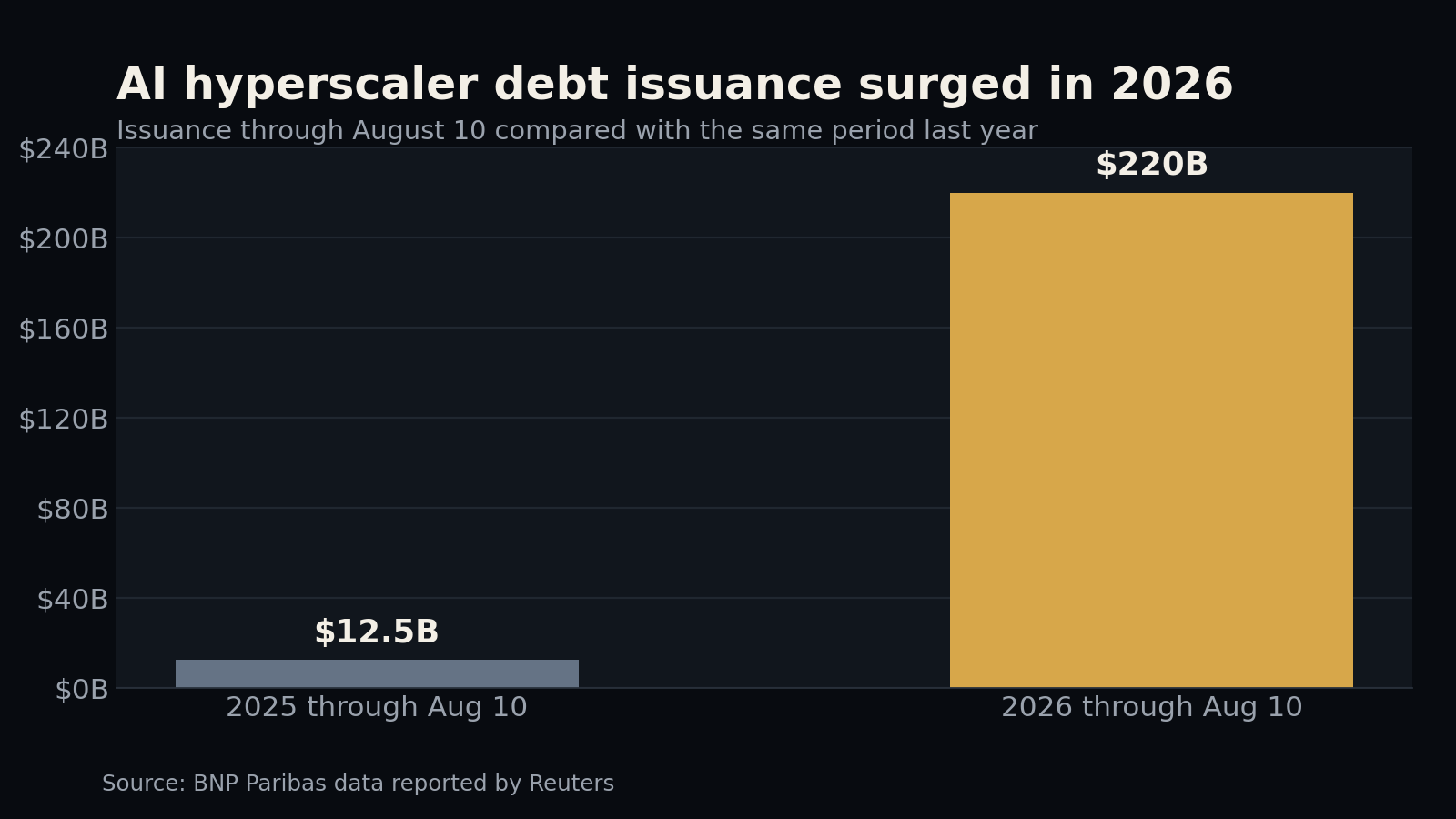
Combined technology spending is expected to exceed $730 billion this year. Companies that once funded expansion largely through internal cash are now increasingly using debt and equity markets. AI hyperscaler debt issuance had already reached approximately $220 billion by August 10, compared with only $12.5 billion during the same period last year.
This creates a strange feedback loop for the trade.
The AI boom requires more financing. That corporate debt competes with already heavy Treasury issuance for investor capital. Investors demand higher yields to absorb the supply, and those higher yields compress the valuations of the same AI companies driving the capital cycle.
AI is not only being pressured by higher yields. The scale of the buildout is now contributing to the supply of debt pushing yields higher.
That does not invalidate the buildout. It raises the cost of carrying it.
We Have Already Seen This Play Out
On August 18, renewed Iran escalation pushed oil and Treasury yields higher. The 30 year briefly reached 5.327%, its highest level since 2007.
The Philadelphia Semiconductor Index fell 5% that day while the Nasdaq declined 1.33%. Nvidia, Micron, Sandisk, and Western Digital were among the technology and semiconductor names under pressure.
That was not proof that AI demand was collapsing. It was a broad reduction in risk centered on inflation, duration, valuation, and positioning.
It also explains why even an outstanding Nvidia report does not automatically lift the entire AI complex. Nvidia can validate demand while the bond market simultaneously questions the price investors should pay for every company connected to that demand.
The fundamentals can remain bullish while the stocks struggle. Both can be true.
Iran Matters, but It Is Not the Entire Story
It would be too simplistic to blame the full move in yields on the war. Fiscal deficits, heavy Treasury issuance, persistent inflation, resilient growth, rising term premium, and record AI related corporate borrowing are all placing pressure on the curve.
The recent move in real yields is important here. Inflation expectations have remained relatively stable while government and corporate bond supply has grown. That tells us the long end is also reacting to a much broader competition for capital.
Still, Iran remains one of the largest immediate and potentially reversible inflation risks. A durable settlement that restores normal shipping through Hormuz could lower the geopolitical premium in oil, give the Fed more room to breathe, and provide real relief for the long duration AI trade.
It would not solve everything. Damaged infrastructure, sanctions, shipping insurance, fiscal borrowing, Treasury supply, and AI related debt issuance would still matter. Ending the war is a relief valve, not a complete fix.
Treasury Buybacks Are Not a Fix Either
Treasury doubled the maximum size of certain long end liquidity support buybacks from $2 billion to at least $4 billion per operation. That can improve liquidity and temporarily relieve pressure, but it is not quantitative easing.
The Federal Reserve can create reserves to finance asset purchases. Treasury cannot. Every dollar of Treasury buybacks must be financed with a dollar of Treasury issuance.
That is why the initial relief in long term yields did not completely hold. Buybacks can improve how the market functions, but they cannot remove the underlying pressure from inflation, monetary policy uncertainty, fiscal deficits, and growing debt supply.

The Takeaway
The high beta AI trade is caught between two powerful forces. The fundamental side remains supported by extraordinary demand, accelerating infrastructure spending, and a buildout that is nowhere near complete. The macro side is demanding a higher return for owning companies whose biggest earnings may still be years away.
My view is that until oil and the long end of the Treasury curve begin trending lower together, strong AI fundamentals may continue producing weaker than expected stock reactions.
This is not necessarily the end of the AI trade. It is the price of financing it in a world where money is no longer cheap.