

Memory: The Cycle Isn’t Dead. The Old Model Is.
An update to my January 25, 2026 thesis
Memory. 메모리. 内存. MEMORY! Are you tired of hearing about it yet?
Nearly seven months ago, I argued that the market was using an outdated framework to understand memory. The consensus debate was simple: “AI demand is astronomical. We are still early.” Or: “Memory has gone parabolic. It is cyclical. Short it.” My argument was that both sides were asking the wrong question.
The question was never whether memory would remain cyclical. Every capital-intensive market is cyclical, including the market for AI infrastructure itself. The real question was whether the old memory cycle could describe a world in which intelligence was moving from model training into persistent, always-on deployment.
Since January 25, we have received an answer. Not a final answer, but a very loud one.
The Datacenter Buildout Still Hasn’t Caught Up
The first part of the thesis was that the “AI Datacenter Boom” was not ending. It was still being physically assembled. That has been confirmed.
Microsoft now expects approximately $190 billion of capital expenditures during calendar 2026, including roughly $25 billion attributed to higher component pricing. Even after that spending and its efforts to accelerate GPU, CPU, and storage deployments, the company still expects to remain capacity constrained through at least 2026. (Microsoft FY2026 Q3 earnings call)
That matters because it comes from the buyer, not the seller. Memory manufacturers have an obvious incentive to describe demand as strong. A hyperscaler saying that it cannot deploy infrastructure quickly enough, even while spending at this scale, is stronger evidence. The infrastructure has not outrun demand. Demand is still waiting for infrastructure.
The Supply “Relief” Arrived, and It Was Already Spoken For
In January, I wrote: Memory supply ≠ deployable supply.
New capacity announcements sound bearish when we treat them as interchangeable blocks of future supply. But a wafer start is not a qualified HBM stack, a packaged accelerator, an enterprise SSD, or a deployed system.
Since then, Samsung and SK hynix have begun shipping HBM4. Samsung announced mass-market HBM4 sales for NVIDIA’s Vera Rubin platform. SK hynix began HBM4 volume shipments during the second quarter and plans to accelerate production in the second half. (Samsung Q1 results), (SK hynix Q2 results)
Supply arrived. The shortage did not disappear. SK hynix says customer demand continues to exceed its supply capability. It has pulled forward the M15X production schedule and is preparing to expand rapidly after the first Yongin fab cleanroom opens in early 2027.
Micron now expects tight DRAM and NAND conditions to persist beyond calendar 2027. More importantly, customers are no longer placing only short-term orders. Micron has signed 16 strategic agreements covering roughly 20% of its DRAM volume and one-third of its NAND volume, generally through 2030. Many include binding volumes and pricing bands. (Micron Q3 presentation), (Micron Q3 10-Q)
That is one of the most important developments since January. Future production is being reserved before it becomes deployable production. The supply response is real. So is the queue waiting for it.
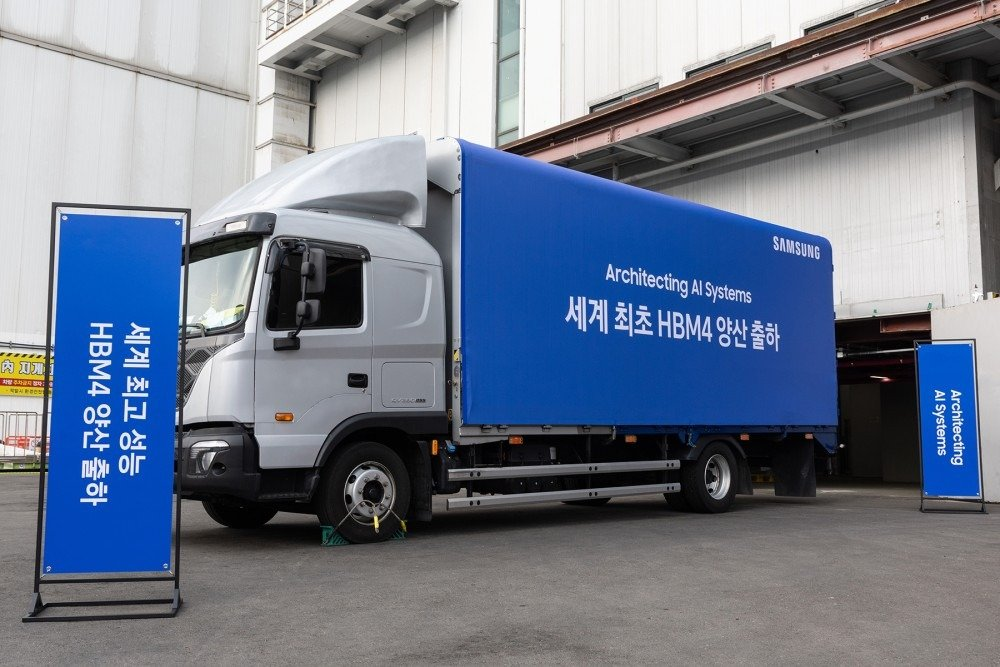
Samsung began commercial HBM4 shipments in February 2026. Supply arrived, but demand continued to exceed deployable capacity.
The “NAND Glut” Never Arrived
This was the most controversial part of the original article and, so far, the strongest confirmation. HBM dominated the narrative because training dominated the narrative. NAND was still treated as a lower-quality commodity that suppliers could easily flood. Then deployment demand began showing up in the financials.
Micron reported that its fiscal third-quarter datacenter SSD revenue exceeded $5 billion and more than doubled sequentially. The company said demand across both DRAM and NAND continued to exceed industry supply by a wide margin. (Micron Q3 results)
Sandisk’s results were even harder to dismiss. Its fiscal 2026 datacenter revenue increased 437% year over year. In the fourth quarter alone, datacenter revenue reached $2.98 billion, up 103% sequentially, while consumer revenue declined 32%. Sandisk also signed a series of longer-term customer agreements that provide firmer demand and financial commitments. (Sandisk fiscal Q4 results)
That mix shift matters. This was not a broad consumer storage recovery being mislabeled as AI. The highest-value growth came from datacenter deployments while consumer demand weakened.
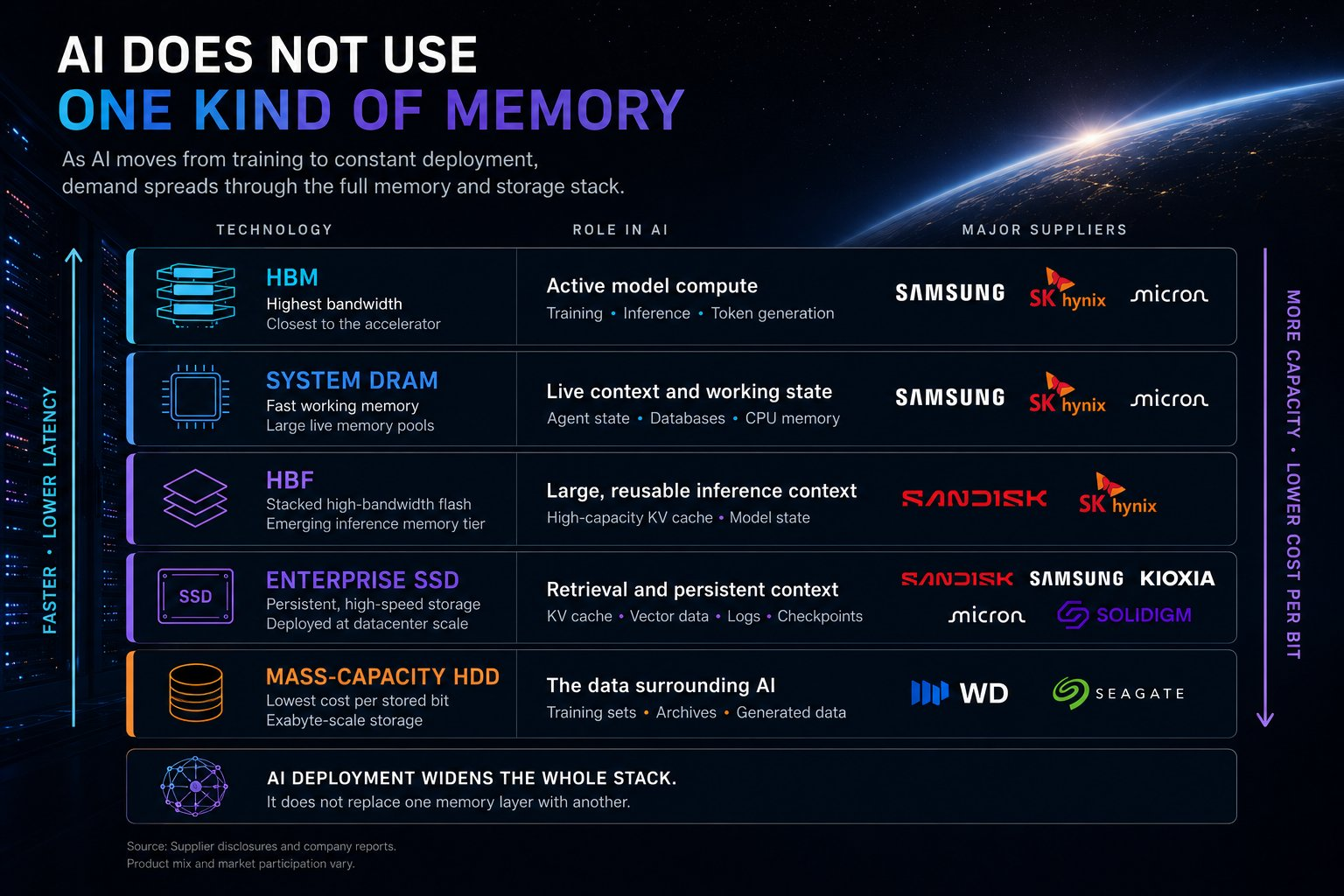
The storage thesis has also moved beyond earnings-call language. Kioxia has presented SSD-based “context memory” designed to extend AI inference caches beyond DRAM. Sandisk and SK hynix have released the first Open Compute Project specification for High Bandwidth Flash, which targets AI inference systems. Storage is becoming part of the inference memory hierarchy, not just the place where completed files go to die. (Kioxia 2026 Investor Day), (Sandisk–SK hynix HBF announcement)
This is where the original argument was headed. Agents do not just generate tokens. They maintain context, retrieve histories, reuse cached states, interact with databases and tools, talk to other agents, and create records of their actions. They store.
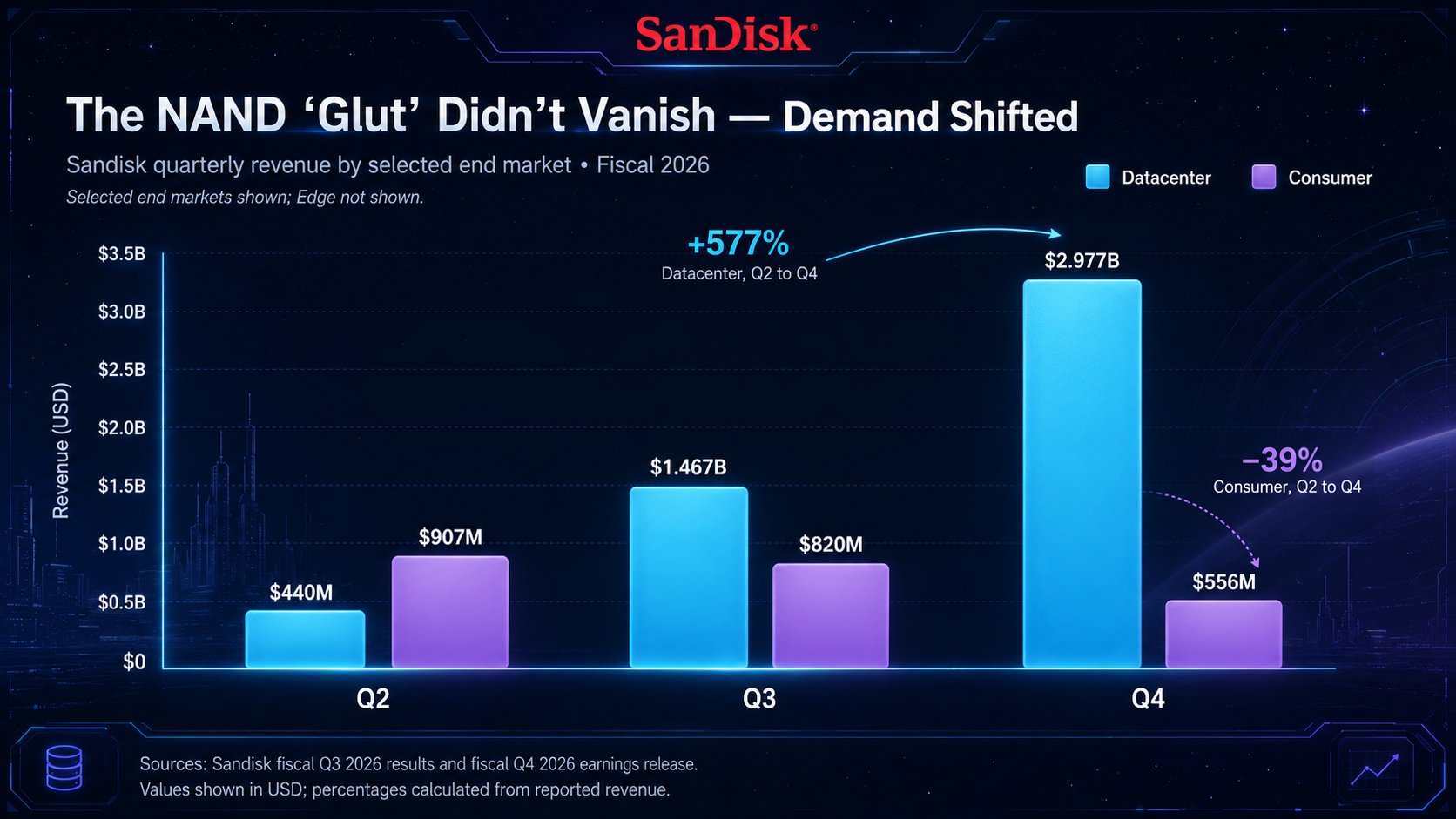
Sandisk’s datacenter revenue rose more than sixfold from fiscal Q2 to Q4 while consumer revenue declined.
Storage Demand Is Broader Than NAND
There is also a distinction worth sharpening. Sandisk is a flash company. Seagate is primarily a hard-drive company. Their products are not interchangeable, and their AI exposure is not identical. But both are responding to the same trend: more computation creates more valuable data.
Seagate’s fiscal fourth-quarter revenue reached approximately $3.6 billion, compared with $2.4 billion a year earlier, while its gross margin rose to 52.3%. For fiscal 2026, free cash flow reached $3.1 billion. Management describes the business as entering a period of structural growth as AI expands data creation and mass-capacity storage needs. (Seagate fiscal 2026 results)
Flash handles latency-sensitive inference, caching, and other high-performance workloads. Hard drives hold the enormous warm and cold datasets around them. AI infrastructure needs both.
Agentic AI Has Started to Reach the Hardware Layer
In January, agentic AI was largely discussed as a software transition. That is changing. Microsoft now describes its business model as moving from a license per worker toward a worker plus an agent, with an added usage component tied to agent activity. Samsung expects agentic AI demand to accelerate and is targeting PCIe Gen6 enterprise SSDs at key-value cache workloads.
This is the critical transition. Training demand is episodic. A model is trained, improved, and retrained. Agentic demand is persistent. An agent must remain available, maintain state, and use infrastructure whenever it acts.
Efficiency gains will reduce the cost of each action, but lower costs also make more actions economical. The relevant unit is no longer only memory per model. It is memory and storage per model, multiplied by users, agents, sessions, and actions.
Physical AI Is Real. The Volume Is Not Here Yet.
The original article argued that memory would become an industrial input as AI moved into vehicles, factories, and robots. That direction is being confirmed, although it is too early to claim that humanoid robot volumes are driving today’s memory shortage.
NVIDIA has released a broader set of tools for robotics, autonomous vehicles, industrial digital twins, and edge systems. These tools turn physical AI workflows into tasks that agents can execute. (NVIDIA physical AI announcement)
More concretely, Micron has signed long-term supply agreements with General Motors and automotive suppliers including Qualcomm, DENSO, Visteon, HARMAN, and Hyundai Mobis. These agreements cover the memory and storage required for increasingly intelligent vehicle platforms. (Micron automotive agreements)
This does not prove that robots consume enough memory to move the global market today. It proves that industrial customers are treating long-term access to memory as strategically important before physical AI reaches mass deployment. That is how a new demand layer should appear: first in the architecture, then in contracts, and finally in volume.
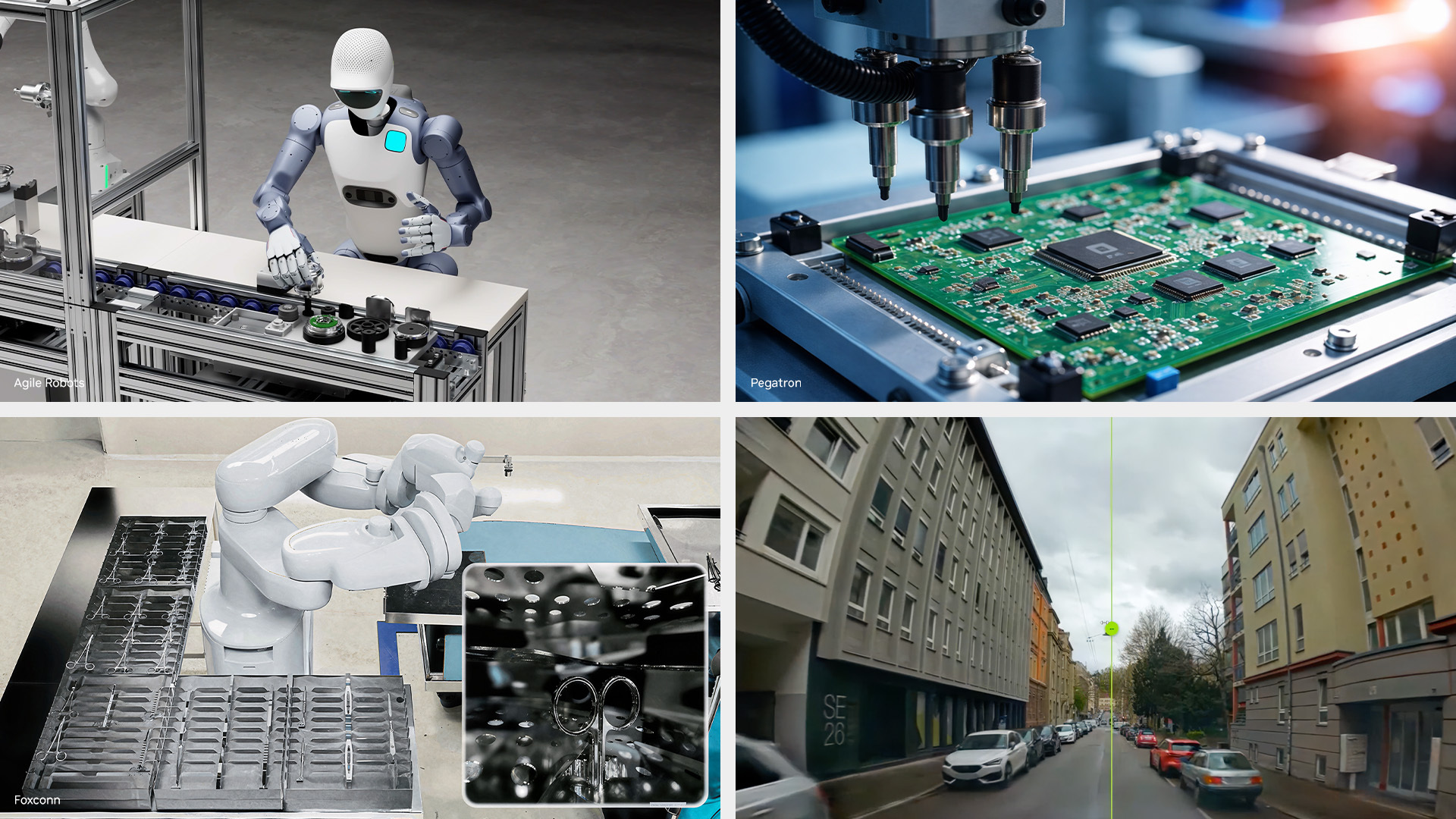
Physical AI is moving from software tools into factories, vehicles, inspection systems, and robots. It is not the main source of memory demand yet, but the deployment layer is forming.
Space Compute Moved From Metaphor to Roadmap
Space compute remains the smallest and most speculative part of the demand thesis, but it is no longer purely hypothetical. NVIDIA announced a space-computing platform in March. It is designed to process large data streams aboard satellites with tightly integrated CPUs, GPUs, interconnects, and memory. (NVIDIA space-computing announcement)
SpaceX has also sought authority for an orbital datacenter constellation that could involve up to one million satellites. That scale is aspirational and faces major economic, thermal, launch, and regulatory limits. Still, it shows that orbital compute has entered serious infrastructure planning. (FCC filing)
Space is not yet a meaningful source of memory volume. It does show that the number of places requiring local, reliable compute and storage continues to grow. The thesis is developing. The revenue is not here yet, and that distinction matters.
So, Is Memory Still Cyclical?
Yes. Prices can overshoot. Customers can double-order. Higher prices can destroy consumer demand. Manufacturing yields can improve, bit density can rise, and new competitors can add supply.
Sandisk’s latest quarter shows both sides. Revenue grew sharply, but about two-thirds of its sequential increase came from pricing and only one-third from volume. Its consumer business also declined. That does not show that the cycle has disappeared. It shows extreme scarcity and aggressive supply allocation.
Meanwhile, SK hynix is accelerating its 321-layer NAND transition, and Sandisk’s newer flash architecture promises higher bit density. These technology changes can create more bits without a matching increase in wafer capacity. Supply will respond eventually.
The bear case has not vanished. It has been delayed, and it needs to become more specific. A credible bear case must identify which memory product becomes oversupplied, when qualified and deployable supply arrives, how much of that supply is already under contract, and which source of demand weakens. It must also explain whether efficiency gains will reduce total infrastructure use faster than usage expands, and at what price weak consumer demand will spread into datacenters.
Those are answerable questions. “Memory is cyclical” is not an answer by itself.
What Actually Changed?
The old cycle was driven by consumer electronics, short-term purchasing, and suppliers racing to add basic capacity. The emerging cycle has longer customer commitments, more specialized products, harder packaging, stricter qualification requirements, and better control of capital spending. Demand is also spreading from training into inference, agents, vehicles, industrial systems, and eventually space.
Memory companies have not escaped cyclicality. But memory is becoming harder to replace, slower to deploy, and more important to customer roadmaps. That can make the cycle longer and raise its floor. It can also shift value away from raw bit production and toward qualified systems, packaging, firmware, and customer relationships.
Most importantly, each wave of “relief supply” can arrive in a market where the definition of demand has already expanded.
Memory, Revisited
In January, I asked whether we would ever outpace demand. That was too absolute. Of course we can outpace demand. The industry has done it before, and it will do it again.
The better question is this: Can supply outpace the rate at which intelligence is being deployed into new systems, new actions, and new environments?
As of August 2026, the answer is still no. HBM remains constrained. General-purpose DRAM has been pulled into the shortage. Enterprise NAND has become a central part of the inference architecture, and mass-capacity storage is benefiting from the data AI creates. Automotive customers are securing supply years in advance. Orbital compute has moved from science fiction into engineering plans.
The cycle is not dead. But if you still model memory as the same commodity cycle that supplied PCs and smartphones, you may be modeling a market that no longer exists.